Esotropia (Inward Squint)
Esotropia is when the eye turns inward, toward the nose. People call it crossed eyes or bhengapan. It is the most common squint in children — and the one most likely to be fixed by glasses alone.
Why the type matters so much
Two children can have eyes that look equally crossed and need completely different treatment — one just needs glasses, the other needs an operation.
The question we answer is simple: is the eye turning in because of focusing strain? If yes, glasses remove the strain and the squint goes. If no, glasses will not help at all.
The two main types
These look similar to a parent but are treated completely differently.
Caused by long sight
- ·Usually starts around age two to three
- ·The child strains to focus, and that strain pulls the eyes in
- ·The right glasses often straighten the eyes completely
- ·Glasses must be worn all day
- ·Eyes turn in again when glasses come off — this is normal
Present from birth
- ·Starts in the first six months of life
- ·Large inward turn, there all the time
- ·Not caused by glasses power
- ·Glasses do not straighten it
- ·Often operated on early so the eyes learn to work together
Other causes
- Poor vision in one eye — from cataract or other problems. An eye that cannot see well drifts inward.
- Nerve weakness affecting the muscle that turns the eye outward. Needs checking quickly, especially if it came on suddenly.
How we check
- Dilating drops to find the real glasses power. Without them a child's focusing hides the long sight that may be causing everything.
- Cover test to confirm it is a real squint and not a false one.
- Measuring the turn for distance and near, with and without glasses. The difference between those tells us the type.
- Vision in each eye separately, to check for lazy eye.
- Eye movements and the inside of the eye, to rule out other causes.
Treatment
- Glasses first, worn all day, and given time to work.
- Patching if one eye has become lazy. We fix vision before alignment.
- Special lenses in some cases, where the turn is much bigger for near work than distance.
- Surgery if a significant turn is still there after the above.
Glasses usually continue after surgery. Stopping them is a common reason for the squint to come back.
Esotropia: before & after
An esotropia case treated by Dr. Shah, showing the eyes before and after squint surgery.
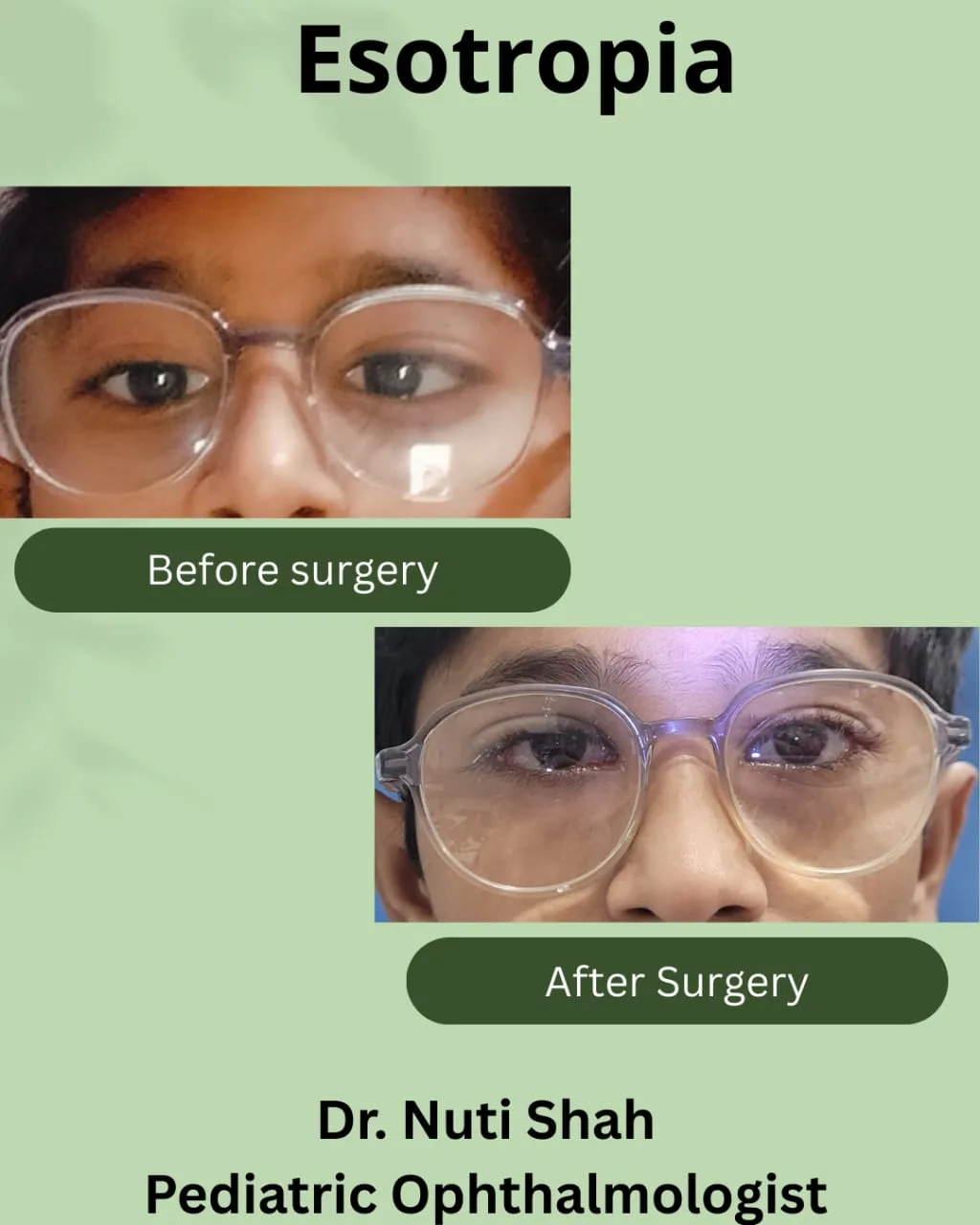
⚕️ Shared with informed consent for educational purposes.See all case studies →
Frequently Asked Questions
Can glasses alone fix esotropia?
Often yes. When the inward turn is caused by long sight, the right glasses can straighten the eyes completely and no surgery is needed.
The glasses must be worn all day. The eyes will turn in again when they come off — that is expected. Some children improve a lot with glasses but still have a small turn left, which may need surgery.
What is the difference between the two main types?
One type starts in the first six months of life, is large and always there, and is not caused by glasses power. Glasses will not fix it, and it usually needs surgery — often early.
The other type starts around age two or three and is caused by long sight. Glasses treat it. They look similar to a parent but are treated completely differently, which is why getting the diagnosis right matters.
My baby's eyes look crossed. Is it always a squint?
No. Many babies have a wide nose bridge or extra skin folds that cover part of the white of the eye, making straight eyes look crossed. This is harmless and goes away as the face grows.
We can tell the difference in a few minutes in the clinic. Since a real squint does better when treated early, it is worth getting checked rather than waiting — especially if the crossing is there all the time.
Is a sudden inward turn serious?
A squint that appears suddenly, causes double vision, or starts in a child older than about five should be checked quickly.
It can be caused by nerve weakness, which sometimes points to a problem that needs attention. The first job is to find out why it happened.
Can esotropia come back after surgery?
The eyes can drift again over time, and some patients need a second operation to fine-tune the result. This is normal and we discuss it before surgery.
Keep wearing the prescribed glasses afterwards. Stopping them is a common reason for the squint to return.
Related
Exotropia (Outward Squint)
The opposite — when the eye turns out instead.
Read moreSquint Surgery
What happens, cost, recovery and results.
Read moreSquint in Children
Signs to watch for, and why early treatment matters.
Read moreAmblyopia (Lazy Eye)
The vision loss that often comes with esotropia.
Read moreContact & Location
Sat: 10:00 AM – 2:00 PM · Sun: Closed
Get an Esotropia Check
Early detection saves sight. Whether it's a routine check-up or a specific concern, we're here to help.